Zapri


CFMR-NC
CFMR.
Tečaji z vzmetnim povratkom
za samodejno vračanje, SUPER tehnopolimer
Automatic return on closing
za samodejno vračanje, SUPER tehnopolimer
Automatic return on closing

IzvedbaOpomba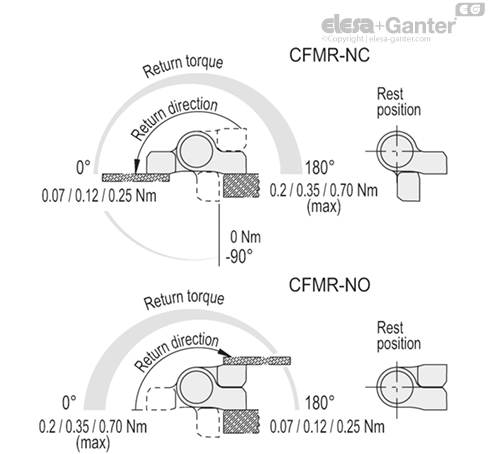
Izvedba
Material
Ohišje iz s steklenimi vlakni ojačanega poliamida (PA), SUPER-tehnopolimer, črna barva, matirana obdelava.
Vrtljivi zatič
z dvema črnima zapornima vijakoma iz termoplasta (POM).
CFMR.67 ima notranjo ojačitev iz aluminija.
Return spring
Plemenito jeklo.
Standardne izvedbe
Prehodne izvrtine za vijake s cilindrično glavo M6.
- CFMR-NC: automatic return on closing.
- CFMR-NC-LB: automatic return on closing, for heavy doors.
- CFMR-NO: automatic return on opening.
- CFMR-NO-LB: automatic return on opening, for heavy doors.
Suffix for torque value of the return spring:
- 020: max return torque 0.20Nm, holding torque 0.07Nm.
- 035: max return torque 0.35Nm, holding torque 0.12Nm.
- 070: max return torque 0.70Nm, holding torque 0.25Nm.
- 100: max return torque 1Nm, holding torque 0.33Nm.
- CFMR-NS: complementary hinge, no return spring.
- CFMR-NS-LB: complementary hinge, without return, without spring, for heavy doors.
Thanks to optimisation of the tribological properties, the CFMR-LB versions make it possible to reduce the friction coefficient and therefore use the hinge on heavier doors.
Opomba
Kot vrtenja (približna vrednost)
Max 270° (-90° and +180° being 0° the condition where the two interconnected surfaces are on the same plane).
The hinge can reach -90 ° but this condition must not be used for CFMR-NO execution.
Do not exceed the rotation limit angle so as not to prejudice the correct operation of the return spring.
Funkcije in zmogljivosti
CFMR hinge is used for the automatic re-closing or re-opening of the door by the return spring.
Navor se postopoma spreminja s kotom odpiranja/zapiranja tečaja.
In specific fatigue stress tests, the return spring exceeded 25.000 cycles (CFMR.35) and 100.000 cycles (CFMR.67) while maintaining the same unaltered torque values.
| Testi upornosti | AKSIALNA OBREMENITEV | RADIALNA OBREMENITEV | OBREMENITEV POD KOTOM 90° |
 |  |  | |
| Opis | Največja omejitev statične obremenitve Sa [N] | Največja omejitev statične obremenitve Sr [N] | Največja omejitev statične obremenitve S90 [N] |
| CFMR.35 | 390 | 600 | 600 |
| CFMR.67 | 2100 | 3500 | 1900 |
Največja statična obremenitev je vrednost, nad katero se lahko material zlomi in s tem ogrozi delovanje tečaja. Seveda je treba za to vrednost uporabiti ustrezen faktor glede na pomembnost in stopnjo varnosti določene uporabe.
Vodič za izbiro
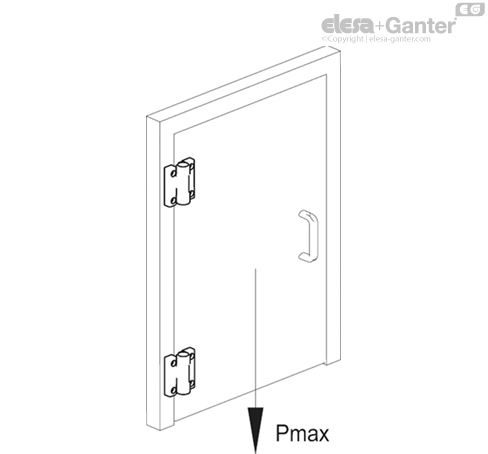
The return force of a door that has a certain weight W (Kg) depends on the spring force of the hinge [Nm] and of the friction between the sliding surfaces between the fixed part and the movable part of the hinge which in turn depend on the tribological properties of the technopolymer used.
The table provides a rough guide for choosing the hinge and its positioning for a specific application.
These values are the result of tests carried out in a laboratory under controlled temperature and humidity (23°C-50% R.H.), under determined conditions of use and for a limited period of time.
Priporočljivo je, da vedno preverite pravilno delovanje za predvideno uporabo.
For further general technical information, consult the Smernice.
| Pmax door weight | Suitable hinges |
| < 3 Kg | CFMR.35-020 + CFMR.35-NS |
| < 5 Kg | CFMR.35-020 + CFMR.35 |
| < 5 Kg | CFMR.67-020 + CFMR.67-NS |
| < 5 Kg | CFMR.67-020 + CFMR.67-020 |
| < 5 Kg | CFMR.67-035 + CFMR.67-NS |
| 5 Kg | CFMR.67-035 + CFMR.67-035 |
| 5 Kg | CFMR.67-070 + CFMR.67-NS |
| 8 kg | CFMR.67-100 + CFMR.67-NS |
| 10 Kg | CFMR.67-070 + CFMR.67-70 |
| 12 kg | CFMR.67-100 + CFMR.67-NS |
| 35 Kg | CFMR.67-070-LB + CFMR.67-NS-LB |
| 40 Kg | CFMR.67-100-LB + CFMR.67-NS-LB |
| 70 Kg | CFMR.67-070-LB + CFMR.67-070-LB |
| 90 Kg | CFMR.67-100-LB + CFMR.67-100-LB |
Pmax= maximum weight of the door that the hinge is able to close with a small residual holding torque tested at a minimum opening angle of 45°.
OPOMBA: this weight depends not only on the geometry of the door (in particular on its centre of gravity) but also on the perfect coaxiality of the hinges.
/RedirectToProductView?storeId=11151&langId=-1004&catalogId=11551&getCategoryPadre=true&=

Vprašajte! Poskusili bomo odgovoriti čim prej.
*obvezno polje
Vaše povpraševanje je bilo poslano in bo obdelano takoj, ko bo mogoče.
Napaka
Mogoče vas zanimajo tudi ti izdelki.